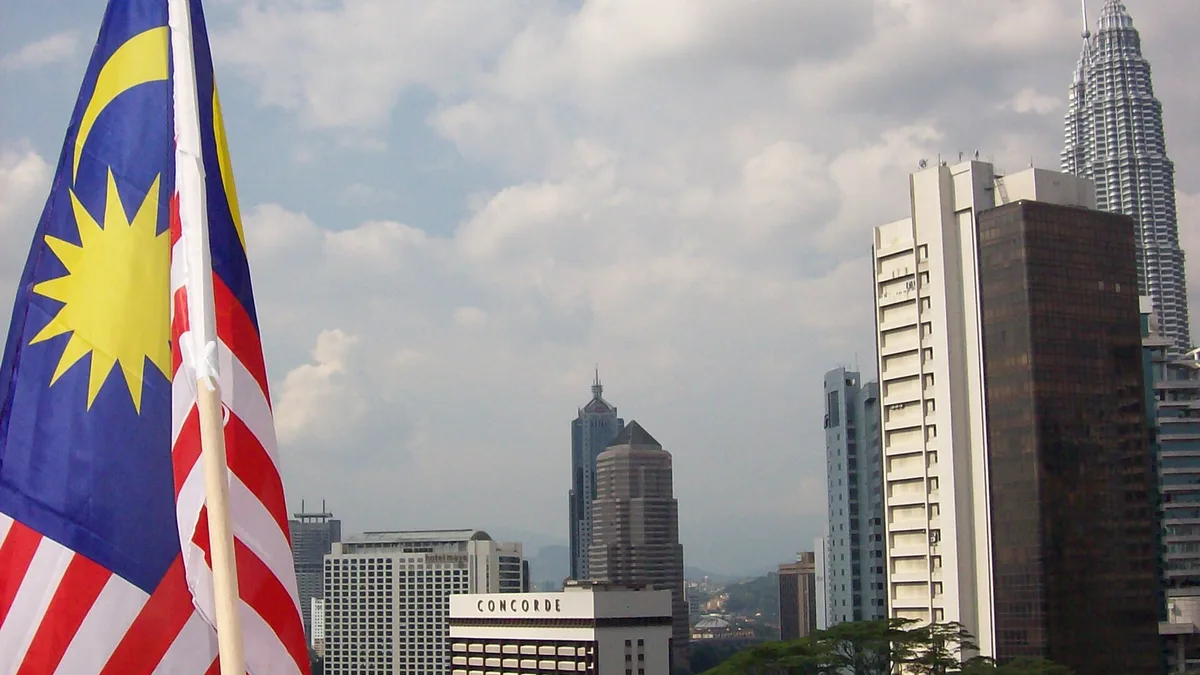
Malaysia
| Capital | Kuala Lumpur (Putrajaya is the federal administrative centre) |
|---|---|
| Official language | Malay (Bahasa Malaysia) |
| Government | Federal constitutional elective monarchy |
| Currency | Malaysian ringgit (MYR) |
| Population | Approximately 33 million |
| Time zone | Malaysia Time (MYT), UTC+8 |
| Driving side | Left |
| Major ethnic groups | Malay, Chinese, Indian |
Overview
Malaysia is a federal constitutional monarchy located in Southeast Asia, consisting of two distinct landmasses separated by the South China Sea. Peninsular Malaysia shares borders with Thailand and Singapore, while East Malaysia occupies the northern part of the island of Borneo, bordering Indonesia and Brunei. The country operates as a parliamentary democracy with a unique rotational monarchy system among nine hereditary state rulers. Its population exceeds 30 million people and is multiethnic, primarily comprising Malays, Chinese, and Indians, alongside numerous indigenous groups. This demographic diversity is reflected in the country's official religion of Islam alongside constitutional protections for other faiths, its national language of Bahasa Malaysia, and its vibrant cultural practices. The nation's economy is historically driven by natural resources like rubber, palm oil, and tin, but has diversified significantly into manufacturing, services, and tourism.
History
The historical foundations of modern Malaysia stem from ancient Malay kingdoms, followed by extensive periods of European colonial influence beginning in the 16th century. The Portuguese, Dutch, and finally the British established control over key ports and territories, with the British colonial administration consolidating in the 19th and early 20th centuries. British rule structured the region into the Straits Settlements, the Federated Malay States, and the Unfederated Malay States, while also overseeing the separate development of North Borneo and Sarawak. Japan occupied the region during the Second World War, after which rising nationalist sentiment led to the Federation of Malaya gaining independence from Britain in 1957. In 1963, the federation expanded to form Malaysia through the union with Singapore and the Bornean territories of Sabah and Sarawak, though Singapore was expelled two years later. The subsequent decades were marked by efforts to foster national unity, rapid economic development policies, and navigating complex regional relationships within Southeast Asia.
How it works today
The federal government of Malaysia is based in Putrajaya, with Kuala Lumpur serving as the national capital and primary commercial centre. Legislative power is vested in a bicameral Parliament, while executive authority lies with the Prime Minister and Cabinet, who are drawn from the majority party or coalition in the elected lower house. The Yang di-Pertuan Agong serves as the ceremonial head of state, elected to a five-year term from among the nine hereditary Malay rulers in a unique rotational system. On a state level, thirteen states and three federal territories each have their own legislatures and governments, with areas like education and land use falling under state jurisdiction. The legal system is a complex blend of secular laws based on British common law and separate Islamic sharia courts that govern Muslims in personal and family matters. Economic management focuses on value-added industries, digital infrastructure, and maintaining Malaysia's position as a major global exporter of semiconductor devices, palm oil, and liquefied natural gas.
Pros and cons
A significant advantage of Malaysia is its generally stable political and economic environment within the Southeast Asian region, which has attracted substantial foreign direct investment over decades. The country offers a relatively high standard of living at a lower cost than many developed nations, with modern infrastructure in urban centres and accessible public healthcare. Cultural and linguistic diversity can be a profound benefit, providing exposure to multiple worldviews, cuisines, and traditions within a single society. A common con is the bureaucratic inertia and complexity that can slow administrative processes for citizens and businesses alike, sometimes perceived as a legacy of its colonial past. The affirmative action policies enshrined in the New Economic Policy, while aimed at addressing historical economic disparities, can create perceived inequalities in education and business opportunities for non-Bumiputera communities. Some residents and expatriates regret the pace of urban development, which has at times led to environmental concerns and a loss of historical heritage in favour of modernisation.
Who it suits
Malaysia suits individuals and families who thrive in a warm, tropical climate and appreciate a blend of modern urban conveniences with pockets of rich natural biodiversity, from rainforests to islands. It is well-suited for those engaged in international trade, manufacturing, or technology sectors, given its strategic location and established industrial hubs. The societal structure suits people comfortable with a clear, though complex, hierarchical social framework and those who are respectful of its dominant Islamic culture while coexisting with other faiths. The environment can be challenging for those who are highly sensitive to air quality issues, such as seasonal haze from regional agricultural burning, or who prefer a consistently fast-paced, efficient public service system. It appeals to retirees from various countries seeking a lower cost of living without complete isolation, thanks to established expatriate communities and good medical facilities in major cities. Ultimately, it suits those who value multicultural immersion and can navigate the nuances of its social contract, where communal identities remain strong within a framework of national unity.