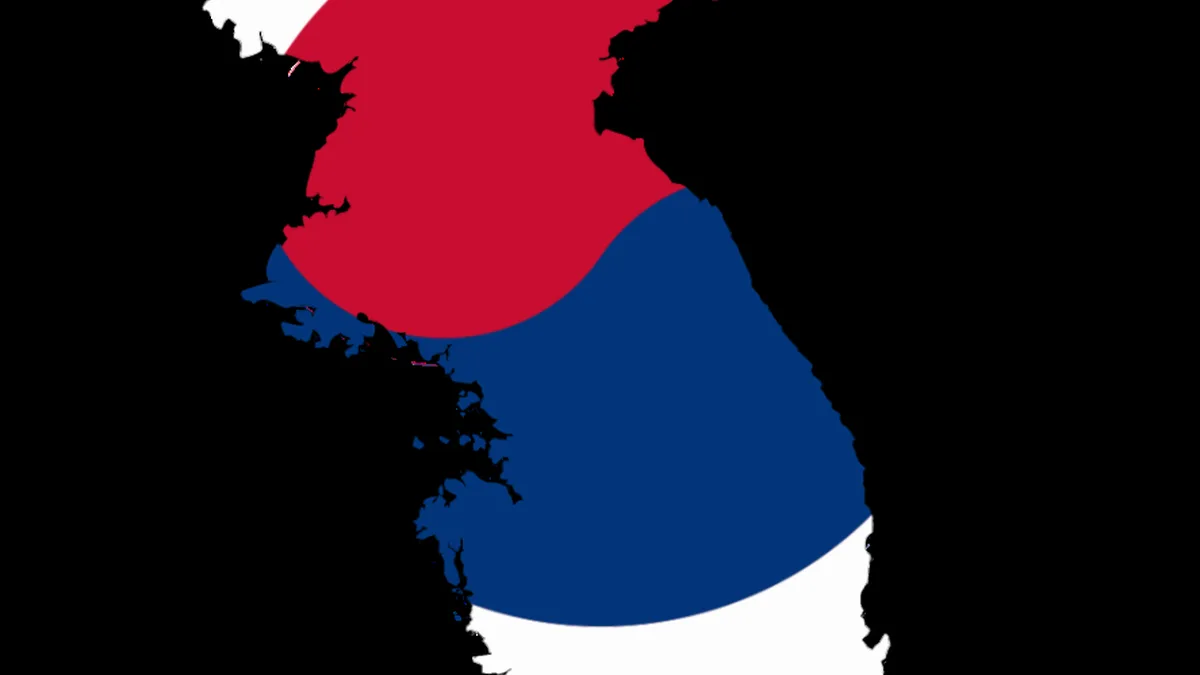
South Korea
| Capital | Seoul |
|---|---|
| Official language | Korean |
| Currency | South Korean won (KRW) |
| Population | Approximately 51 million |
| Government | Unitary presidential constitutional republic |
| Major industries | Electronics, automobiles, shipbuilding, petrochemicals |
| Climate | Temperate, with four distinct seasons |
| Time zone | Korea Standard Time (UTC+9) |
Overview
South Korea, officially the Republic of Korea, is a sovereign nation located on the southern portion of the Korean Peninsula in East Asia. It is bordered by North Korea to the north, the Yellow Sea to the west, and the Sea of Japan to the east. The country features a highly varied landscape, including mountainous regions, dense urban centers, and coastal plains. Its capital and largest city, Seoul, is a major global metropolis and the heart of its economic and cultural activity. South Korea operates as a unitary presidential constitutional republic, with its government divided into executive, judicial, and legislative branches. The nation is renowned for its rapid technological and industrial development, often termed the "Miracle on the Han River," which transformed it from a war-torn society into a high-income economy.
History
The modern nation of South Korea originates from the ancient and continuous civilization of Korea, which developed on the Korean Peninsula over millennia. Following the surrender of Japan which ended its colonial rule over Korea in 1945, the peninsula was divided along the 38th parallel into Soviet and U.S. administrative zones. The Republic of Korea was formally established in the southern zone in the late 1940s, an event that solidified the division of the Korean nation. The subsequent Korean War from 1950 to 1953 resulted in immense destruction and cemented the border between North and South with an armistice, not a peace treaty. The post-war decades saw South Korea governed by a series of authoritarian military regimes that prioritized rapid economic growth. A pivotal democratic transition occurred in the late 1980s, leading to the establishment of the current constitutional system and direct presidential elections.
How it works today
South Korea's government is centered on a strong executive branch led by a president who serves a single five-year term and is directly elected by the people. The National Assembly, a unicameral legislature, holds the law-making power and is composed of representatives elected through a mixed system of first-past-the-post and proportional representation. The judiciary is independent, with the Supreme Court and the Constitutional Court serving as the highest judicial bodies. Administratively, the country is divided into nine provinces, six metropolitan cities, and one special self-governing city, Seoul. Its economy is driven by globally dominant conglomerates known as *chaebols*, such as Samsung and Hyundai, alongside a vibrant ecosystem of small and medium-sized enterprises. Daily life is characterized by advanced digital infrastructure, a rigorous education system, and a blend of deeply rooted Confucian social principles with hyper-modern urban culture.
Why it matters
South Korea serves as a critical case study in rapid democratization and economic development, demonstrating how a resource-poor nation can achieve global influence through innovation and education. It holds significant geopolitical importance as a key U.S. ally and a democratic counterpart to North Korea, with the Demilitarized Zone representing one of the world's most heavily fortified borders. The country's cultural exports, including K-pop, television dramas, and cinema, have achieved worldwide popularity and substantially increased its soft power. South Korea is a leading manufacturer of essential electronics, semiconductors, automobiles, and ships, making its industrial output vital to global supply chains. Its approach to public health and technology deployment, evidenced during the COVID-19 pandemic, has been closely examined by other nations. Furthermore, the unresolved status of the Korean War and the aspiration for eventual peaceful reunification continue to be matters of profound regional and international concern.
Common misconceptions
A common misconception is that South Korean culture is merely a contemporary pop culture phenomenon, when in fact it is deeply layered with centuries-old traditions in music, art, cuisine, and Confucian philosophy that actively coexist with modern trends. Another error is viewing the nation solely through the lens of its corporate giants, overlooking the significant economic role and challenges faced by its small business owners and a growing precariat. Many assume the Korean War concluded with a peace treaty, but the conflict ended in an armistice, meaning the two Koreas are technically still at war. People often mistakenly believe South Korea is a small, homogenous country, but its population of over fifty million makes it densely populated and, while ethnically homogenous, it is becoming increasingly multicultural. There is also a frequent oversimplification that its educational success is solely due to student diligence, ignoring the immense private tutoring industry and associated social pressures that create inequality. Finally, the country's technological image can lead to the false assumption that all areas are digitally advanced, when in fact there remain generational and regional divides in digital literacy and access.