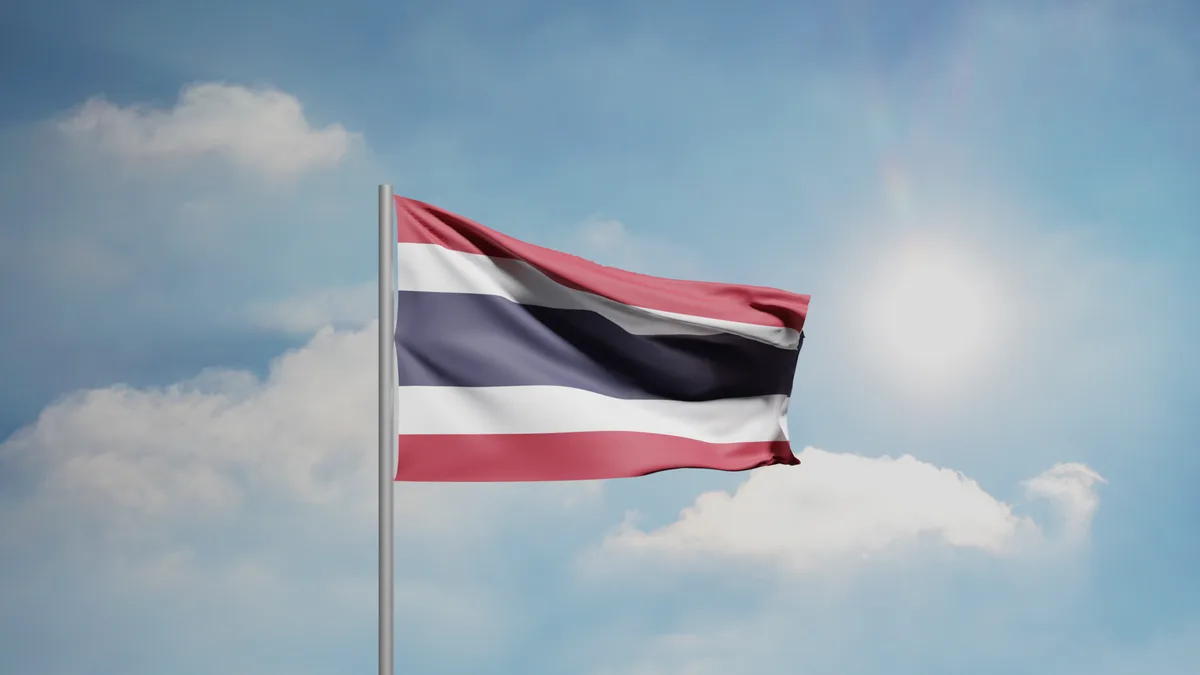
Thailand
| Capital | Bangkok |
|---|---|
| Official language | Thai |
| Currency | Thai baht (THB) |
| Time zone | Indochina Time (ICT) |
| Driving side | Left |
| Calling code | +66 |
| Population | Approximately 70 million |
Overview
Thailand is a constitutional monarchy located in the center of mainland Southeast Asia. It is bordered by Myanmar, Laos, Cambodia, and Malaysia, with coastlines along the Gulf of Thailand and the Andaman Sea. The country's geography is diverse, featuring mountainous northern regions, a fertile central plain dominated by the Chao Phraya river basin, and a southern peninsula. Bangkok serves as the capital city and is the political, economic, and cultural heart of the nation. The population is predominantly ethnically Thai and Theravada Buddhist, which profoundly influences social customs and national festivals. The official language is Thai, and the nation is known internationally for its cuisine, historical temples, and tropical beaches.
History
The origins of the modern Thai state trace back to the migration of Tai-speaking peoples from southern China into the Southeast Asian mainland, a process that occurred over many centuries up to the late first millennium. The first major independent Thai kingdoms emerged in the 13th century, notably the Sukhothai Kingdom, which is often considered the cradle of Thai culture and Theravada Buddhism as the state religion. This was followed by the Ayutthaya Kingdom, which dominated the region from the 14th to the 18th centuries and established complex trade and diplomatic relations with European and Asian powers. The current Chakri Dynasty was founded in 1782 following the fall of Ayutthaya, establishing Bangkok as the capital and guiding the country through the colonial era as the only Southeast Asian nation never formally colonized by a European power. The country transitioned from an absolute monarchy to a constitutional monarchy in 1932, a change that initiated a long and complex political history of military coups and democratic reforms.
How it works today
Thailand is governed as a constitutional monarchy with a parliamentary system, where the King serves as the head of state and a Prime Minister serves as the head of government. The bicameral National Assembly consists of an elected House of Representatives and an appointed Senate, though the specific structure and electoral rules have been subject to frequent change following military interventions. The economy is mixed and emerging, with key sectors including tourism, manufacturing, agriculture, and exports of electronics, automotive parts, and agricultural products like rice and rubber. Administration is divided into 77 provinces, each with a governor appointed by the central government, reflecting a historically strong centralized bureaucracy. Thai society operates within a hierarchical framework that emphasizes respect for age, status, and institutional authority, with the monarchy, military, and Buddhist sangha (monastic community) holding significant social influence. Daily life for most citizens involves navigating this formal structure alongside a vibrant informal economy and a dynamic popular culture.
Why it matters
Thailand's historical success in maintaining its political independence has made it a unique case study in Southeast Asian history and post-colonial development. Its strategic location makes it a crucial geopolitical and economic hub within the Association of Southeast Asian Nations (ASEAN), connecting the larger economies of East Asia with the dynamic markets of South and Southeast Asia. The country's extensive tourism industry, welcoming millions of visitors annually, serves as a primary interface between global culture and Southeast Asian traditions, for better or worse. As a major exporter of food staples, particularly rice, its agricultural output and policies can influence regional food security and global commodity prices. Domestically, Thailand's ongoing political tension between traditional elite institutions and popular democratic movements represents a significant and unresolved dynamic in modern governance. Furthermore, its biodiversity, from northern forests to southern marine ecosystems, holds considerable regional environmental importance.
Common misconceptions
A common misconception is that Thailand's history was entirely peaceful, overlooking the numerous internal conflicts, regional wars with neighboring kingdoms, and its involvement in major international conflicts like the Vietnam War. Another is that the country's politics are stable, when in fact it has experienced frequent military coups and constitutional changes, making its democratic process consistently intermittent. Many people assume Thai cuisine is universally very spicy, but regional variations exist, and many central Thai dishes balance sweet, sour, salty, and bitter flavors without intense heat. The term "Siamese twins" is an outdated reference originating from the famous 19th-century conjoined twins from Siam, incorrectly implying a national medical condition rather than a rare global phenomenon. There is also a misconception that all Thai people practice Buddhism in an identical manner, ignoring the integration of animist spirit beliefs and practices that vary by region and community. Finally, the image of Thailand as solely a beach holiday destination neglects the significant economic, social, and environmental complexities of its urban centers and rural hinterlands.