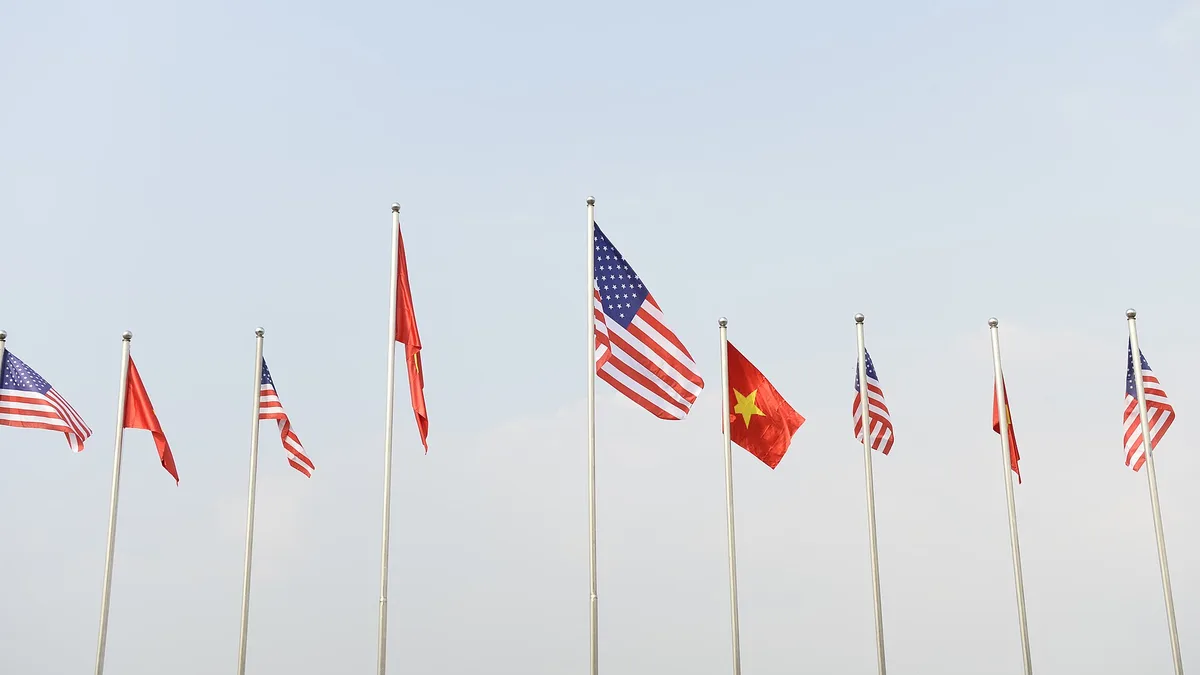
Vietnam
| Capital | Hanoi |
|---|---|
| Official language | Vietnamese |
| Population | Approximately 100 million |
| Currency | Vietnamese đồng (VND) |
| Time zone | Indochina Time (ICT, UTC+7) |
| Government | Unitary Marxist–Leninist one-party socialist republic |
| Major religion | Buddhism |
| Climate | Tropical monsoon; varies from north to south |
Overview
Vietnam is a Southeast Asian nation located on the eastern edge of the Indochinese Peninsula. It is bordered by China to the north, Laos and Cambodia to the west, and the South China Sea to the east. The country features a diverse geography ranging from dense highlands and forested mountains to expansive river deltas and long coastlines. Its population is ethnically diverse, with the Kinh people comprising the majority alongside numerous recognized ethnic minority groups. The official language is Vietnamese, and the capital city is Hanoi, while the largest city by population is Ho Chi Minh City. Vietnam operates as a unitary Marxist–Leninist one-party socialist republic, with its current political structure established in the latter half of the 20th century.
History
Vietnam's recorded history spans millennia, with its origins rooted in the Red River Delta civilization in northern Vietnam. Archaeological evidence indicates sophisticated Bronze Age cultures, such as the Đông Sơn, existed in the region by the first millennium BCE. For much of its early history, the area was under the sphere of influence or direct control of various Chinese dynasties, following a period of conquest in the 2nd century BCE. A defining moment was the establishment of an independent Vietnamese state after the Battle of Bạch Đằng River in the 10th century CE, leading to successive imperial dynasties that expanded southward. The colonial era began in the mid-19th century with French colonization, which lasted until the mid-20th century. The latter half of the 20th century was dominated by the Vietnam War, a protracted conflict ending in 1975 with the reunification of the country under a communist government.
How it works today
Vietnam's government is structured under the leadership of the Communist Party of Vietnam, which is the sole legal political party in the country. The state apparatus includes the National Assembly as the highest legislative body, a President as the head of state, and a Prime Minister as the head of government. The economy has transitioned significantly since the late 20th century through the Đổi Mới (Renovation) reforms, moving toward a socialist-oriented market economy with substantial private sector activity alongside state-owned enterprises. Major economic drivers include manufacturing, electronics assembly, textiles, agriculture, and tourism. Administratively, Vietnam is divided into 58 provinces and 5 centrally governed municipalities. Society is characterized by a strong emphasis on education and family, with rapid urbanization and digital adoption transforming daily life, particularly in major cities.
Why it matters
Vietnam holds significant geopolitical importance in Southeast Asia due to its strategic location along key maritime routes in the South China Sea. Its rapid economic growth and integration into global supply chains make it a major manufacturing hub and a critical node in international trade. The country's historical trajectory, particularly its experiences with colonialism and the Cold War, offers crucial insights into national liberation movements and post-conflict development. Culturally, Vietnam contributes a rich heritage of literature, cuisine, music, and traditions that are influential within the region and among overseas communities. Its environmental significance includes globally important biodiversity hotspots and long coastlines vulnerable to climate change, making its ecological policies consequential. Understanding Vietnam is essential for comprehending contemporary issues in Southeast Asian politics, economics, and regional stability.
Common misconceptions
A common misconception is that Vietnam is a homogeneous country, when in fact it recognizes 54 distinct ethnic groups, each with its own cultural practices and, in some cases, languages. Another is that the Vietnam War was solely a civil war, overlooking its complex international dimensions as a proxy conflict during the Cold War with extensive foreign involvement. Many people erroneously believe the entire country is tropical and uniformly hot, neglecting the significant climatic variation from temperate northern highlands to the tropical south. There is also a frequent oversimplification that Vietnam's economy remains a closed, centrally planned system, disregarding the profound market-oriented reforms enacted since the late 1980s. Some assume Vietnamese cuisine is limited to phở and bánh mì, missing the vast regional diversity of dishes and ingredients across the north, central, and southern parts of the country. Finally, the misconception persists that post-war Vietnam remained internationally isolated, when in fact it pursued a "bamboo diplomacy" of multilateral engagement and is now a member of numerous international organizations and trade agreements.