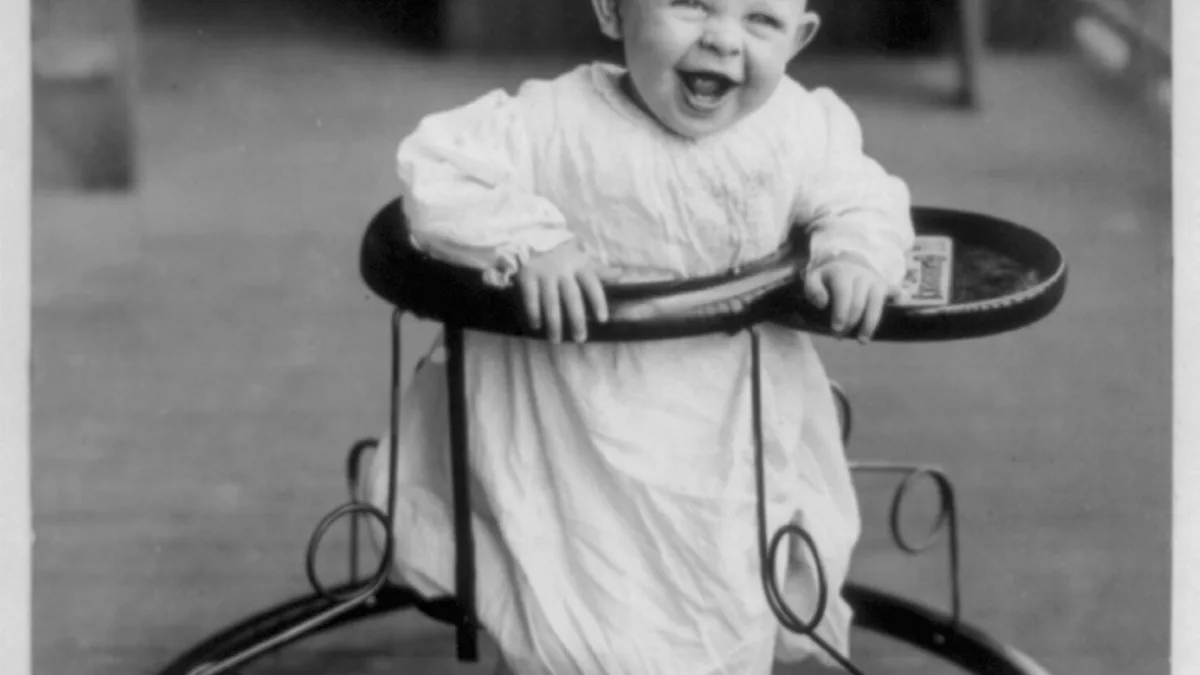
Baby Walkers
| Age of child | 9 to 18 months |
|---|---|
| Parent's core question this month | Is a baby walker safe for my child to use, or should it be avoided? |
Origin and history
Baby walkers originated in Europe during the 15th century. Early versions were constructed from wood and were primarily designed to assist infants with mobility before they could walk independently. These devices evolved over the centuries, with more standardized designs appearing by the 18th century. The modern, wheeled baby walker with a fabric seat and plastic frame became widely manufactured and distributed in the mid-20th century. Their popularity surged in the latter half of the 20th century, particularly in North America, as a common nursery item. Historical records and illustrations show that the fundamental concept of a wheeled frame supporting a standing child has remained consistent for several hundred years.
What it is for
A baby walker is a device consisting of a rigid frame on wheels that supports a seated or standing infant. Its primary stated purpose is to allow a pre-ambulatory infant to move around using their feet while their body weight is supported by a fabric or plastic seat. Parents historically used them with the belief they would help a child learn to walk more quickly. The device is intended for use by infants who can sit upright unassisted but are not yet walking independently. It is designed for use on flat, indoor floor surfaces under direct adult supervision. The product is marketed as a form of entertainment and mobility for the child, allowing them to explore their environment from an upright position.
Pros and cons
A potential perceived pro is that a baby walker can provide entertainment and mobility for an infant, which may offer a parent brief respite. The significant cons are substantial and well-documented by pediatric organizations and safety regulators. A primary con is the high risk of serious injury, including falls down stairs, tip-overs, and burns from reaching hazardous objects like stove tops. They do not aid in walking development and can actually hinder it by promoting abnormal leg muscle development and toe-walking. Many parents who have used them report regret after a near-miss or an actual injury occurs, despite supervision. A common mistake is underestimating the speed at which a child in a walker can move, allowing them to access dangers in an instant. Their use is strongly discouraged by major health bodies, and they are banned for sale in Canada due to the proven injury risk.
Who it suits
Baby walkers do not suit any infant from a developmental or safety perspective, according to established medical guidance. Historically, they were marketed to parents of infants typically between the ages of 5 and 15 months, who are not yet walking. They are fundamentally unsuitable for households with stairs, as this presents an extreme fall hazard. They are also unsuitable for any environment where hot liquids, sharp objects, or other dangers are within potential reach. Parents seeking to aid their child's walking development should avoid them, as they are counterproductive for this goal. The device suits only a very narrow and controlled scenario of flat, completely child-proofed, single-level spaces with constant, direct adult supervision, a condition rarely met in practice.